Showing posts with label Bibi Netanyahu. Show all posts

Saturday, January 11, 2014

A Lion Of Judah Has Passed!

Ariel "Arik" Sharon (1928-2014)

It is with a heavy heart that I announce the death of former Prime Minister Ariel "Arik" Sharon.

He was born on 26 February 1928 in Kfar Malal. At age 10, Sharon entered the Zionist youth movement Hassadeh.

As a young teenager, he first began to take part in the armed night-patrols of his moshav. In 1942 at the age of 14, Sharon joined the Gadna, a paramilitary youth battalion, and later the Haganah, the underground paramilitary force and the Jewish military precursor to the Israel Defense Forces (IDF).

Sharon's unit of the Haganah became engaged in serious and continuous combat from the autumn of 1947, with the onset of the Battle for Jerusalem. Without the manpower to hold the roads, his unit took to making offensive hit-and-run raids on Arab forces in the vicinity of Kfar Malal. In units of thirty men, they would hit constantly at Arab villages, bridges and bases, as well as ambush the traffic between Arab villages and bases.

From the Jewish Virtual Library:
In 1953, he founded and led the “101” special commando unit which carried out retaliatory operations against Palestinian fedayeen. Sharon was appointed commander of a Paratroop Corps in 1956 and fought in the Sinai Campaign. In 1957, he attended the Camberley Staff College in Great Britain.

Between 1958 and 1962, Sharon served as Infantry Brigade Commander and then Infantry School Commander, and then attended Law School at Tel Aviv University. He was appointed Head of the Northern Command Staff in 1964 and Head of the Army Training Department in 1966. He participated in the 1967 Six Day War as commander of an armored division. In 1969 he was appointed Head of the Southern Command Staff.

Sharon resigned from the army in June 1972, but was recalled to active military service in the 1973 Yom Kippur War to command an armored division. He led the crossing of the Suez Canal which helped secure an Israeli victory in the war and eventual peace with Egypt.

Ariel Sharon was elected to the Knesset in December 1973, but resigned a year later, serving as Security Adviser to Prime Minister Yitzhak Rabin (1975). He was elected to the Knesset in 1977 on the Shlomzion ticket. Following the elections, he joined the Herut party and was appointed Minister of Agriculture in Menachem Begin's first government (1977-81). One of his priorities was to pursue agricultural cooperation with Egypt.

In 1981, Ariel Sharon was appointed Defense Minister, serving in this post during the Lebanon War, which brought about the destruction of the PLO terrorist infrastructure in Lebanon. In the realm of international relations, he was instrumental in renewing diplomatic relations with the African nations which had broken off ties with Israel during the Yom Kippur War. In November 1981, he brought about the first strategic cooperation agreement with the U.S. and widened defense ties between Israel and many nations. He also helped bring thousands of Jews from Ethiopia through Sudan.

In 1983, Sharon resigned as Defense Minister after a government commission found him indirectly responsible for the September 1982 massacre of Palestinians at the Sabra and Shatila refugee camps by Lebanese Phalangists.

Sharon remained in the government as a minister without portfolio and then served as Minister of Industry and Trade from 1984-90. In this capacity, he concluded the Free Trade Agreement with the U.S. in 1985.

In 1998, Ariel Sharon was appointed Foreign Minister and headed the permanent status negotiations with the Palestinian Authority.

While serving as Foreign Minister, Sharon met with U.S., European, Palestinian and Arab leaders to advance the peace process. He worked mostly to create and advance projects such as the Flagship Water Project funded by the international community to find a long-term solution to the region's water crisis and a basis to peaceful relations between Israel, Jordan, the Palestinians and other Middle Eastern countries.

Following the election of Ehud Barak as Prime Minister in May 1999, Ariel Sharon was called upon to become interim Likud party leader following the resignation of Benjamin Netanyahu. In September 1999, he was elected Chairman of the Likud. He also served as a member of the Foreign Affairs and Defense Committee in the Knesset.

On September 28, 2000, Sharon made a visit to the Temple Mount in Jerusalem, the holiest place in Judaism to emphasize Israel's claim to sovereignty over the Temple Mount. Palestinians maintained that Sharon came with “thousands of Israeli soldiers” and defiled a Muslim holy place, when in fact, Israel's Internal Security Minister Shlomo Ben-Ami permitted Sharon to visit the Temple Mount only after calling Palestinian security chief Jabril Rajoub and receiving his assurance that if Sharon did not enter the mosques, no problems would arise. Sharon did not attempt to enter any mosques and his 34 minute visit was conducted during normal hours when the area is open to tourists. Palestinian youths — eventually numbering around 1,500 — shouted slogans in an attempt to inflame the situation. Some 1,500 Israeli police were present at the scene to forestall violence.

Following Sharon's Temple Mount visit, the Palestinians, under the direction of Yasser Arafat, launched an unprecendented wave of violence and terror against Israelis, dubbed the “al-Aksa Intifada” by the Palestinians for its association with the al-Aksa Mosque located on the Temple Mount. Palestinian leaders claim that Sharon's visit sparked the violence, but on November 7, 2000, an investigatory committee led by former U.S. Senator George Mitchell was established to determine the causes of the violence and to make recommendations for calming the situation. The Mitchell Report issued in April 30, 2001, concluded “the Sharon visit did not cuase the “al-Aksa intifada.”

In a special election held February 6, 2001, Ariel Sharon was elected Prime Minister. He presented his government to the Knesset on March 7, 2001. After calling early elections to the 16th Knesset, which were held on January 28, 2003, Ariel Sharon was charged by the president with the task of forming a government and presented his new government to the Knesset on February 27, 2003.

After several years of bloodshed, terror, and stalled peace talks with the Palestinians, Sharon devised a bold plan that would ensure a higher degree of security for Israelis, and improve the lives of Palestinians. While Palestinian terrorism against Israelis was at its peak, and going virtually unchecked by Arafat and other Palestinian leaders, Sharon decided that Israel should act unilaterally to improve its security situation and reduce bloodshed. This plan, known as the disengagement plan, called for the complete withdrawal of Israeli troops and settlers in the Gaza Strip, as well as the dismantlement of all settlements in the area, including four settlements in northen Samaria. Between August 16 and August 30, 2005, Israel safely evacuated more than 8,500 Israeli settlers and, on September 11, 2005, Israeli soldiers left Gaza, ending Israel's 38-year presence in the area.

The implementation of the disengagement plan was viewed as a success by most of the Israeli public, although it sparked bitter protests from ministers of Sharon's Likud Party, causing a party schism. Facing bitter infighting in Likud, Sharon formally resigned from the party to form a new centrist party, “Kadima,” or “Forward” on November 21, 2005.

Following the Likud Party spilt, Sharon outlined the goals of his new party. One, he said, is to closely follow the United States-backed road map plan for peace with the Palestinians. Sharon declared that there will be no more unilateral withdrawals from the West Bank, and insisted that Palestinian terrorist groups be disarmed and dismantled. The Kadima party platform calls for “maximum security and assuring that Israel be a Jewish national home and that another state that shall arise be demilitarized, with terrorists disarmed.”

In mid-December, 2005, Sharon spent two days in a hospital after suffering a minor stroke, which doctors said caused no irreparable brain damage. However, on January 4, 2006, Sharon was rushed to the hospital following another, more serious stroke. Sharon suffered a massive brain hemorrhage, which caused extensive cerebral bleeding.

Prime Minsterial duties were turned over to Ehud Olmert, who held a cabinet meeting on January 5, 2006, to signal the transfer of power. Olmert was subsequently elected Prime Minister until elections on March 28, 2006.
President George W. Bush said that Sharon was “a man of courage and peace,” and that “on behalf of all Americans, we send our best wishes and hopes to the prime minister and his family.”

“Arik was a brave soldier and a daring leader who loved his nation and his nation loved him. He was one of Israel’s great protectors and most important architects, who knew no fear and certainly never feared vision, He knew how to take difficult decisions and implement them. We all loved him and he will be greatly missed,” Simon Perez.

“The State of Israel bows its head over the passing of former prime minister Ariel Sharon.  His memory will forever be held in the heart of the nation. Sharon played a central role in the struggle for Israel’s security throughout its existence. He was, first and foremost, a courageous fighter and a distinguished general, one of the greatest commanders the IDF has ever known. When he left the military, he continued to act on behalf of the people of Israel, both in the capacity of the many roles he filled in Israel’s successive governments and as the country’s eleventh prime minister,” continued the prime minister. “He will forever be remembered.” Benjamin Netanyahu.

"One of the state of Israel’s greatest soldiers and warriors before and since it was founded. He was directly in the line of fire throughout his entire life” – first on the frontlines of battle, then on the political frontlines.

“Arik’s life story is fascinating, extraordinary and unique, imbued with courage, human kindness, vision, and leadership,”- Ehud Olmert

Ariel Sharon's family was by his side when he passed. He nursed remarked that he was fighting for life until the end.

Except for the disastrous pull out from Gaza, Ariel Sharon was an exceptional leader of the nation of Israel.  If he hadn't had the stroke that felled him, I do believe that Israel would have taken a different direction in policy.

Today a Lion of Judah has gone.  His like will not return for a long time!


Thursday, November 21, 2013

Worthless Concessions

With Obamacare falling apart, and new scandals arising every other week (soon to be weekly), and his foreign policy going South faster than a Cheetah on crack, President Barack Hussein Obama needs a "victory" somewhere with anyone fast.  In this case it will be a atrocious agreement with the Mullah's of Iran.
From Debka

The Iranian negotiators face the delegations of six world powers in Geneva Thursday, Nov. 21, with strict orders not to give ground on the two major sticking points holding up a first-step deal on their nuclear program: The heavy water reactor under construction at Arak for producing plutonium and Iran’s “right” to uranium enrichment. If Iran gains those two points, whatever concessions its negotiators may come up with are worthless, because they will leave Tehran in possession of two optional nuclear weaponizing tracks instead of one - plutonium as well as enriched uranium.

debkafile’s sources report that Tehran is fighting tooth and nail for Six-Power acknowledgement of its “right to enrich uranium” – ostensibly to come away from Geneva with a “historic feat” to show the Iranian people that the economic hardship they suffered under economic sanctions was worth the candle.

But concession of this “right” has a more sinister purpose: It would give Iran’s nuclear aspirations the enormous boost of an international license to keep its uranium enrich facilities, including the underground plant in Fordo and the centrifuge production line, fully intact and ready to go at any time.

The infrastructure already standing, say US intelligence sources, is capable of topping up enriched uranium stockpiles already in hand to the amount needed for five nuclear bombs in less than a month – 26 days is the number often cited. The second option of plutonium would also be available when the Arak reactor is finished.

US, Russian and British sources are presenting the gap in the resumed Geneva talks Thursday as minor and bridgeable.

debkafile’s sources say they are just playing for time to chip away at a draft accord that by its nature would be a compromise solution which gives ground to Tehran.

And what compromise can be expected when Washington failed to challenge Iranian leader Ayatollah Ali Khamenei’s avowal on Day One of the Geneva talks that Iran will not step back “one iota” from its nuclear rights, and his grotesquely barbaric rant against Israel as “the roguish, filthy, rabid dog of the region,” whose regime is “doomed to extinction?”

This degraded language, not heard since the Nazi German era, informed the Obama administration in the harshest terms that for the sake of a deal, Iran will not give an inch under pressure, whether from economic sanctions or from Israel and parts of the American Jewish leadership.

Khamenei also blasted US government as unworthy of trust.

If President Barack Obama was serious in his often repeated commitment to Israel’s security, he ought to have protested in some way against Khamenei’s unspeakable rhetoric, possibly even delaying the proceedings before they started their second day in Geneva. But the Iranian leader apparently got away with it, judging from the Obama administration’s mild response – a senior US official said it was “uncomfortable,” but did not condemn it as unacceptable like the French President Francois Hollande, and the British Foreign Secretary William Hague declined any comment at all, fearing to rock the boat in Geneva.

Their evasions told Tehran that Washington and London are so hooked on closing a deal at this time that they can be trusted to find some way around the Arak and enrichment hurdles to reach their goal.

The French team alone stood out in Geneva against Iran’s continuing construction of the Arak reactor, arguing that possession of this facility would nullify any other concessions Tehran might offer.
The military has reminded Obama that their readiness has been destroyed by his policies towards the military and that they cannot mount an attack on Iran to stop them.  Thus the need for an "agreement".

The last time John Kerry tried to sign a bad agreement with Iran the French stopped the agreement.  But with many companies already gearing up to supply Iran, the French will not do the same again.  After the the P5+1 nations will not be living under an Iranian nuclear bomb.  Israel, Saudi Arabia, Kuwait, etc... are!  But to Barack Hussein Obama and his pro-Iranian advisor Valerie Jarrett, the only thing that is important is that Obama looks good right then.

Israel and Saudi Arabia are talking about a mutual security pact.  Israel is worried and Saudi Arabia is scared.  Just one thing, is Israel worried enough to try and stop Iran?

Wednesday, September 18, 2013

Obama To Iran: Keep Components, Just Promise Not To Weaponise Them.

By Findalis of Monkey in the Middle


The Obama Regime's policy of Appeasement is coming along nicely with the latest pronouncements to the Iranians.
From Debka

The moderate mien of Iran’s new president Hassan Rouhani has had its intended effect – even before nuclear dialogue began. President Barack Obama had only one demand of Tehran: “Iran would have to demonstrate its own seriousness by agreement not to weaponise nuclear power,” he said Wednesday, Sept. 18. He thus took at his word Iran’s supreme leader Ayatollah Ali Khamenei, who declared the day before: “We are against nuclear weapons. And when we say no one should have nuclear weapons, we definitely do not pursue it ourselves either.”

The symmetry between the words from Washington and Tehran was perfect in content and timing – and not by chance.

debkafile’s Washington and Iranian sources disclose that it was choreographed in advance.

Obama and Khamenei have been exchanging secret messages through Sultan Qaboos bin Said Al Said of Oman, who visited Tehran in the last week of August and conferred with both Khameini and Rouhani.

In the last message, carried to Tehran by Oman’s Defense Minister Sayyid Badr bin Saud Al Busaidiat, the US president said that Rouhani’s conciliatory gestures towards Washington needed to be backed up by an explicit pledge not to weaponise Iran’s nuclear program.

That pledge must come from the supreme leader in person and delivered publicly to Iran’s most hawkish audience, Revolutionary Guards chiefs.

And indeed, Khamenei acted out his part Tuesday under TV cameras.

Full details of the exchanges going back and both between Washington and Tehran will appear in the coming DEBKA Weekly 603 out Friday, Sept. 20.

They will confirm that the US president has come to terms with a nuclear-capable Iran and will be satisfied with Ayatollah Khamenei’s word that Tehran will not take the last step to actually assemble a bomb.

Our sources note that in his direct secret dialogue with Tehran, Obama is pursuing the same tactics he used for the Syrian chemical issue with Russian President Vladmir Putin: Moving fast forward on the secret track while pretending that the process is still at an early stage and then a sudden leap to target – a particular form of diplomacy consisting of verbal calisthenics.

This pretense was played out at the G20, when the two presidents acted as though they were irreconcilably divided on the Syrian question, while secretly tying up the ends of the chemical accord.

Obama’s willingness to accept Khamenei’s oft-repeated assurance that his country’s nuclear program is solely for peaceful purposes – while letting its military program advance to the brink – leaves Prime Minister Binyamin Netanyahu lagging far behind and his Iranian policy with nowhere to go.

At the Israeli cabinet meeting Tuesday, the prime minister said his White House talks with President Obama on Sept. 30 would focus on Iran and his four demands:
  1. Complete halt of uranium enrichment;
  2. Removal of enriched materials from Iran;
  3. Closure of the Fordo enrichment plant;
  4. Termination of plutonium production at Arak.
Notwithstanding the briefing offered by Secretary of State John Kerry when he visited Jerusalem on Sunday, Sept. 15, it looks as though Obama is keeping the Israeli prime minister in the dark on his moves towards Iran.
Who but an idiot would actually believe that Iran would not weaponize any nuclear components that they have in their possession?  Once again Obama is trying to throw Israel under the bus.  But will Netanyahu let him do this to Israel?  Members of the Obama Regime have quietly told Netanyahu that if Israel attacks Iran the US will NOT block any sanctions and/or boycotts done to Israel by the UN Security Council.  Blackmail is the Obama way.

Israel will soon be standing alone in the world without a friend.  The perfect solution for his Muslim Brotherhood Masters.  Isolate Israel, destroy Israel then finish the job started in 1933.  Problem solved and World Peace reigns.

I for one do not believe that Prime Minister Netanyahu would believe anything Obama or Kerry is saying to him.  I do believe he is buying time, but will it be time enough to prevent a nuclear bomb being exploded over Tel Aviv?  I pray it is.

Saturday, September 24, 2011

Let That Light Be The Light Of Peace

by Findalis of Monkey in the Middle

The Full Text of Bibi Netanyahu's speech to the United Nations

Ladies and gentlemen, Israel has extended its hand in peace from the moment it was established 63 years ago. On behalf of Israel and the Jewish people, I extend that hand again today. I extend it to the people of Egypt and Jordan, with renewed friendship for neighbors with whom we have made peace. I extend it to the people of Turkey, with respect and good will. I extend it to the people of Libya and Tunisia, with admiration for those trying to build a democratic future. I extend it to the other peoples of North Africa and the Arabian Peninsula, with whom we want to forge a new beginning. I extend it to the people of Syria, Lebanon and Iran, with awe at the courage of those fighting brutal repression.

But most especially, I extend my hand to the Palestinian people, with whom we seek a just and lasting peace.

Ladies and gentlemen, in Israel our hope for peace never wanes. Our scientists, doctors, innovators, apply their genius to improve the world of tomorrow. Our artists, our writers, enrich the heritage of humanity. Now, I know that this is not exactly the image of Israel that is often portrayed in this hall. After all, it was here in 1975 that the age-old yearning of my people to restore our national life in our ancient biblical homeland — it was then that this was braided — branded, rather — shamefully, as racism. And it was here in 1980, right here, that the historic peace agreement between Israel and Egypt wasn’t praised; it was denounced! And it’s here year after year that Israel is unjustly singled out for condemnation. It’s singled out for condemnation more often than all the nations of the world combined. Twenty-one out of the 27 General Assembly resolutions condemn Israel — the one true democracy in the Middle East.

Well, this is an unfortunate part of the U.N. institution. It’s the — the theater of the absurd. It doesn’t only cast Israel as the villain; it often casts real villains in leading roles: Gadhafi’s Libya chaired the U.N. Commission on Human Rights; Saddam’s Iraq headed the U.N. Committee on Disarmament.

You might say: That’s the past. Well, here’s what’s happening now — right now, today. Hezbollah-controlled Lebanon now presides over the U.N. Security Council. This means, in effect, that a terror organization presides over the body entrusted with guaranteeing the world’s security.

You couldn’t make this thing up.

So here in the U.N., automatic majorities can decide anything. They can decide that the sun sets in the west or rises in the west. I think the first has already been pre-ordained. But they can also decide — they have decided that the Western Wall in Jerusalem, Judaism’s holiest place, is occupied Palestinian territory.

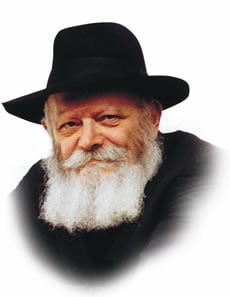
Menachem Mendel Schneerson
And yet even here in the General Assembly, the truth can sometimes break through. In 1984 when I was appointed Israel’s ambassador to the United Nations, I visited the Great Rabbi of Lubavich. He said to me — and ladies and gentlemen, I don’t want any of you to be offended because from personal experience of serving here, I know there are many honorable men and women, many capable and decent people serving their nations here. But here’s what the rebbe said to me. He said to me, you’ll be serving in a house of many lies. And then he said, remember that even in the darkest place, the light of a single candle can be seen far and wide.

Today I hope that the light of truth will shine, if only for a few minutes, in a hall that for too long has been a place of darkness for my country. So as Israel’s prime minister, I didn’t come here to win applause. I came here to speak the truth. The truth is — the truth is that Israel wants peace. The truth is that I want peace. The truth is that in the Middle East at all times, but especially during these turbulent days, peace must be anchored in security. The truth is that we cannot achieve peace through U.N. resolutions, but only through direct negotiations between the parties. The truth is that so far the Palestinians have refused to negotiate. The truth is that Israel wants peace with a Palestinian state, but the Palestinians want a state without peace. And the truth is you shouldn’t let that happen.

Ladies and gentlemen, when I first came here 27 years ago, the world was divided between East and West. Since then the Cold War ended, great civilizations have risen from centuries of slumber, hundreds of millions have been lifted out of poverty, countless more are poised to follow, and the remarkable thing is that so far this monumental historic shift has largely occurred peacefully. Yet a malignancy is now growing between East and West that threatens the peace of all. It seeks not to liberate, but to enslave, not to build, but to destroy.

That malignancy is militant Islam. It cloaks itself in the mantle of a great faith, yet it murders Jews, Christians and Muslims alike with unforgiving impartiality. On September 11th it killed thousands of Americans, and it left the twin towers in smoldering ruins. Last night I laid a wreath on the 9/11 memorial. It was deeply moving. But as I was going there, one thing echoed in my mind: the outrageous words of the president of Iran on this podium yesterday. He implied that 9/11 was an American conspiracy. Some of you left this hall. All of you should have.

Since 9/11, militant Islamists slaughtered countless other innocents — in London and Madrid, in Baghdad and Mumbai, in Tel Aviv and Jerusalem, in every part of Israel. I believe that the greatest danger facing our world is that this fanaticism will arm itself with nuclear weapons. And this is precisely what Iran is trying to do.

Can you imagine that man who ranted here yesterday — can you imagine him armed with nuclear weapons? The international community must stop Iran before it’s too late. If Iran is not stopped, we will all face the specter of nuclear terrorism, and the Arab Spring could soon become an Iranian winter. That would be a tragedy. Millions of Arabs have taken to the streets to replace tyranny with liberty, and no one would benefit more than Israel if those committed to freedom and peace would prevail.